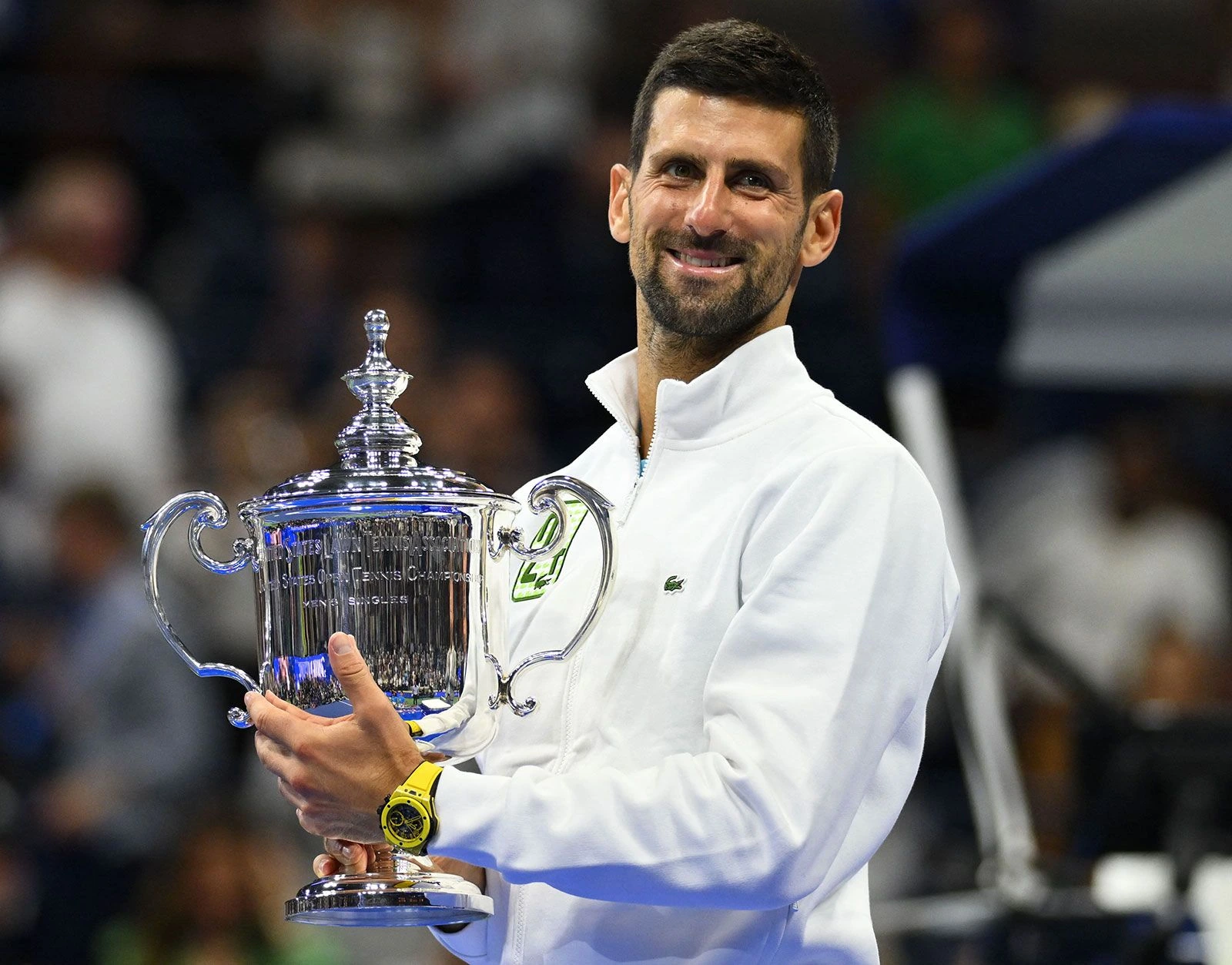
As of March 2026, Novak Djokovic's net worth is estimated at roughly $220 to $240 million USD. The most widely cited figure comes from Celebrity Net Worth, which pegs it at $240 million. Forbes, which tracks career prize money separately, reported his on-court earnings alone at $189 million as of August 2025, not counting off-court income. So the credible range most sources land in is $200 million to $250 million, with $220 to $240 million being the most defensible middle ground right now.
What Is Djokovic’s Net Worth in USD and How It’s Calculated

Marko Radivojević
27 Mar 2026
Why the number varies depending on where you look

Net worth estimates for athletes like Djokovic are educated approximations, not audited financial statements. No public record lists every asset, debt, and investment Djokovic holds. What you see on sites like Celebrity Net Worth or Forbes is a model built from public data: verified prize money payouts, reported endorsement deal values, known business ventures, and then a rough subtraction for taxes, agent fees, and lifestyle costs. The methodology matters. Forbes typically separates "on-court" from "off-court" earnings in its annual highest-paid tennis player lists, which is why you might see a Forbes figure that looks different from an all-in net worth estimate elsewhere. If you're comparing numbers across websites, check whether the figure is career prize money only, annual income, or total net worth, because those are three very different things.
For a deeper look at how analysts arrive at these totals, Novak Djokovic's net worth according to Forbes breaks down the methodology that publication uses when ranking tennis players by earnings.
Tennis prize money: the foundation of his wealth
Prize money is the most verifiable part of Djokovic's wealth because the ATP publishes official payout data. Forbes confirmed his career prize money had crossed $189 million by August 2025, making him the highest-earning tennis player in history by on-court income. To put that in perspective, the men's singles champion at the 2025 US Open earned $5 million, and the runner-up earned $2.5 million. A Wimbledon runner-up slot in 2025 was worth roughly $1.78 million. Djokovic has won 24 Grand Slam titles and appeared in finals and semifinals at majors for over two decades, so the cumulative payout is enormous.
Prize money, though, is gross income, not take-home pay. After agent commissions (usually 10 to 15 percent), coach and support team salaries, travel, and taxes across multiple countries, the actual wealth retained from prize money is meaningfully lower than the headline number. Analysts typically estimate that a top tennis player keeps around 40 to 55 cents on every dollar of gross prize earnings as real net wealth, depending on their tax situation. Still, $189 million in gross career prize money is a massive foundation to build from.
Endorsements and sponsors: where the real money compounds

For elite players at Djokovic's level, off-court income often exceeds what they earn on the court in any given year. Djokovic has held major endorsement deals with brands including Lacoste (apparel), Peugeot, Hublot, and others across his career. These deals are rarely disclosed in full detail publicly, but industry estimates have put his annual endorsement income in the range of $20 to $30 million per year during his peak earning years. Forbes' highest-paid tennis player lists consistently rank him at or near the top, factoring in both prize money and sponsorship income in their annual calculations.
Appearance fees are another off-court income stream that rarely gets discussed in mainstream coverage. Djokovic, as one of the most recognizable athletes in the world, commands significant fees for exhibition matches and events. These payments are typically private and not publicly reported, but they add meaningfully to annual income totals.
Business ventures and investments beyond tennis
Djokovic has used his wealth to build a portfolio of businesses. The most prominent is his wellness and restaurant brand. He co-founded Novak Café & Restaurant in Monte Carlo and has been associated with a gluten-free, plant-based food philosophy that he's turned into a commercial venture. He has invested in wellness and health-focused businesses, reflecting his well-documented personal interest in nutrition and sports performance.
He has also been a visible advocate for player rights and was one of the founding figures behind the Professional Tennis Players Association (PTPA), which he launched in 2020. While this isn't a direct revenue stream, it reflects how he's building influence and positioning himself for post-playing career opportunities, which will likely include media, coaching advisory roles, and continued brand partnerships.
Real estate is another wealth driver. Djokovic has owned property in Monaco and Belgrade, and high-value real estate is a standard part of how wealthy athletes preserve capital. The specific valuations of his properties aren't publicly confirmed, so most net worth models treat this as a contributing factor without attaching a precise number.
His age, career stage, and what's shifted recently
Djokovic was born on May 22, 1987, which puts him at 38 years old as of March 2026. That context matters because career stage significantly affects earning power for any athlete. By 2025, Djokovic was competing at a reduced schedule compared to his peak years, with younger players like Jannik Sinner and Carlos Alcaraz dominating the top rankings. Fewer tournament victories mean fewer prize payouts, and a lower world ranking can affect the perceived commercial value of endorsement deals.
That said, Djokovic's brand value doesn't decline at the same rate as his ranking. He remains one of the most recognized and respected names in global sports. His 24 Grand Slam record, his longevity, and his international following (particularly strong in Europe and Asia) mean sponsors still see significant ROI in associating with him even in the late stages of his playing career. His net worth is unlikely to drop sharply in the near term because his wealth is now largely asset-based, not income-dependent. The compounding effect of two-plus decades of top-tier earnings, invested and managed, means his $220 to $240 million range is relatively stable even as active prize money slows.
For context on how other top tennis players' wealth compares, it's worth looking at Grigor Dimitrov's net worth, which illustrates how career longevity and endorsement reach can shape an athlete's financial picture differently.
How to check the most reliable figure today
No single website has an audited, authoritative figure. Here's how to get the most grounded answer:
- Start with the ATP Tour's official career prize money leaders page. This gives you the verified on-court earnings total, which is the most concrete number available. As of mid-2025, Djokovic's verified career prize money was $189 million.
- Check Forbes' highest-paid tennis players list for the most recent year. Forbes separates on-court and off-court income and is generally more methodologically transparent than celebrity net worth aggregator sites.
- Use Celebrity Net Worth ($240 million) and similar sites as ballpark estimates, not precision figures. These models include assumptions about taxes saved, investment returns, and unlisted income that may or may not reflect reality.
- Look for recent news about his endorsement status. If a major sponsor has ended or renewed a deal, that's a real signal about current off-court income.
- Factor in his recent tournament results. A Wimbledon or US Open final appearance adds $1.5 to $5 million directly to his verifiable income in any given year.
The honest answer is that $220 to $240 million is the best range available with public data as of early 2026. The $189 million career prize money figure from Forbes is the single most credible anchor point. Everything above that number reflects estimated off-court income, business equity, and investment returns, all of which are modeled, not confirmed. If you need a single number for a conversation, $240 million is defensible and widely cited. If you need a range for any research or analytical purpose, $200 to $250 million reflects what responsible estimates show across major sources.
For a comprehensive look at how these figures are tracked and updated over time, Novak Djokovic's net worth covers the full financial picture with additional sourcing context.
FAQ
Is Djokovic’s net worth the same as his career prize money total?
No. Career prize money is only the on-court portion and is reported as gross payouts. Net worth adds modeled off-court income, business equity, and investment value, then subtracts estimated expenses, taxes, and fees, so the figures can be very different.
Why do estimates differ so much between sites like Forbes and Celebrity Net Worth?
Because they often use different endpoints, for example “on-court earnings” versus “total net worth,” and they apply different assumptions for taxes, agent commissions, endorsement deal sizing, and how much of lifestyle costs are already accounted for.
How accurate are net worth numbers for athletes, given they are not audited?
They are best treated as ranges, not exact statements. The biggest uncertainty usually comes from undisclosed endorsement contract details, private real estate valuations, and how much profit a business actually generates versus just revenue.
Do estimates include Djokovic’s taxes and agent fees?
Some models back-calculate take-home value by applying standard commission and cost assumptions, but others may largely present gross earnings and then infer remaining wealth. That is why two websites can both be “credible” yet land on different totals.
What portion of Djokovic’s net worth is most verifiable?
His tournament winnings are the most verifiable because official ATP payout data can be checked and aggregated. Everything else, especially business equity and investment performance, is estimated from secondary information and assumptions.
If his prize money slowed by 2025, should his net worth be dropping too?
Not necessarily. Net worth can stay stable or even grow if prior earnings were invested, real estate appreciates, and ongoing sponsorship or business equity continues to produce value, even when annual on-court payouts are lower.
How do endorsement deals affect net worth versus annual income?
Endorsements primarily drive annual income, but net worth increases only if that income is saved, invested, or used to build equity in businesses. Some estimates also blend contract value and expected future earnings, which can make them look higher than current-year cashflow.
Does the Monaco restaurant and wellness venture count as revenue in net worth calculations?
Usually not directly as “revenue.” Net worth models typically treat such ventures as business equity, which depends on profitability and valuation multiples. If the business has high expenses or limited disclosures, the equity value may be included as a conservative estimate rather than full revenue.
How are real estate holdings treated when valuations are not public?
Most net worth models include real estate as a contributing factor without attaching a precise number, or they estimate using comparable sale prices and typical market assumptions. That can shift totals by tens of millions across different sites.
Is it reasonable to use a single number like $240 million in articles or conversations?
Yes, if you are comfortable with simplification. The article’s suggested single-number approach relies on picking the upper end that is widely cited, but for research or reporting, a range is safer because the off-court portion is modeled rather than confirmed.
Next Article
Novak Net Worth: How to Estimate Djokovic’s Wealth Reliably
Estimate Novak Djokovic net worth with a reliable method, verifying sources and breaking down earnings, brands, and vent